
Friday, August 12, 2016

Saturday, August 29, 2015


Monday, August 24, 2015
WHERE DO WE GO AFTER DEATH........?
WHERE DO WE GO AFTER DEATH........?

Abstract
The innumerable recorded and researched cases of past life experiences clearly point to life after death. In all the recorded cases of reincarnations, it was found that there was a variable time lag between the death of the person and his next reincarnation on Earth. So, where do we go after death till our reincarnation on Earth? Is it a single plane of existence or are there a variety of planes of existence? If so, what are the factors that decide where we go after death? In this article, we present the answers to these and other questions about this topic. These answers are obtained through spiritual research done by seekers of the Spiritual Science Research Foundation (SSRF) with highly developed sixth sense (ESP).
Note: In order to understand this article better, it is recommended that you read the article on the three subtle basic components of Sattva, Raja and Tama.
Table of Contents [show]
1. What happens after death?
Spiritual research has shown that man is comprised of the following four basic bodies:
- Physical
- Mental
- Causal or intellectual
- Supracausal or subtle ego
The picture below is a diagrammatic representation of what a human being is comprised of.
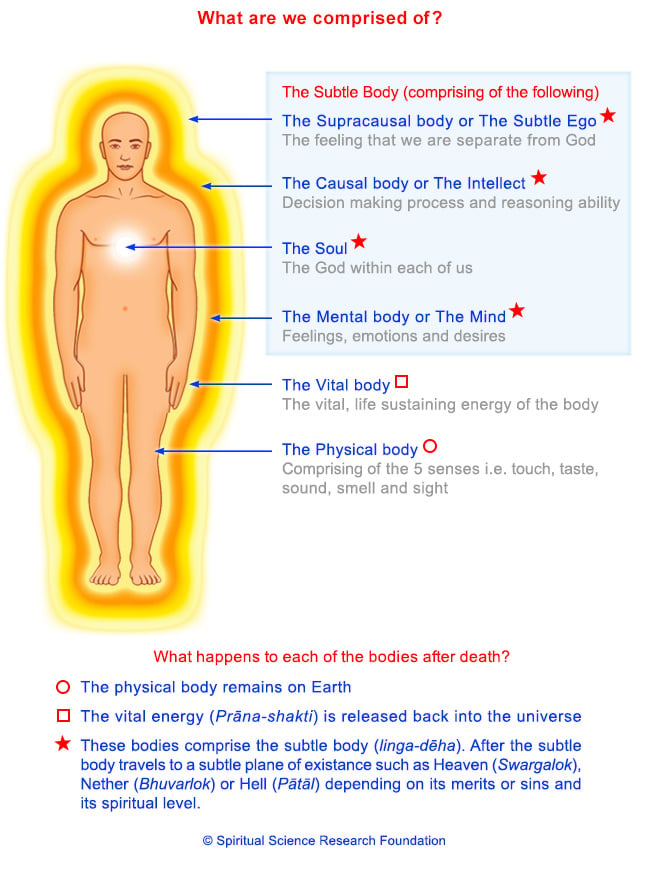
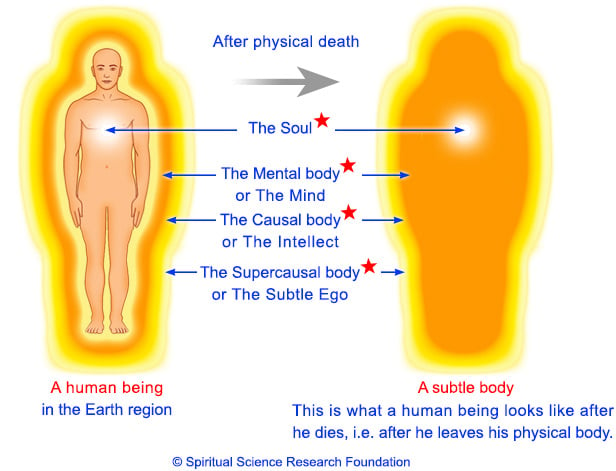
When a person dies the physical body ceases to exist. However, the rest of his existence or consciousness continues. The existence of the person minus the physical body is known as the subtle body (linga-dēha) and it comprises of the mental, causal (intellect) and supracausal (subtle ego) bodies. This subtle body then goes to one of the 13 subtle planes of existence other than the Earth plane.
2. The 14 planes of existence in the Universe
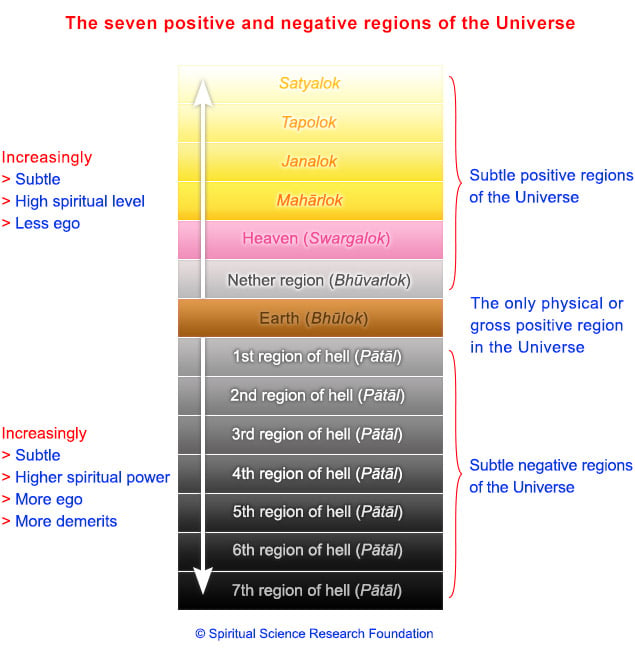
There are 14 main planes of existence in the Universe. Seven of them are positive planes of existence and seven are negative planes of existence. The seven negative planes of existence are commonly known as Hell (Pātāl). There are numerous sub-planes within these main planes of existence.
Righteousness (Dharma) is that which accomplishes the 3 tasks of: Keeping the social system in excellent condition Bringing about the worldly progress of every living being Causing progress in the spiritual realm as well. – Shri Adi Shankaracharya
Seven positive planes of existence: The planes of existence occupied mostly by living persons and subtle bodies doing righteous deeds and engaged in spiritual practice according to the positive path of spiritual practice are known as the seven positive planes of existence or saptalok. By positive path, we mean the orientation of spiritual practice is towards God-realisation, which is the ultimate in spiritual growth.
The Earth plane is the only physical plane of existence in the Universe and is also the first plane of existence in the hierarchy of the positive planes of existence in the Universe.
Seven Negative planes of existence: These are planes of existence occupied mostly by subtle bodies that have done unrighteous deeds and are engaged in spiritual practice according to the negative path. By negative path, we mean the orientation of spiritual practice is towards attaining spiritual power, e.g. supernatural powers. This spiritual power is primarily used to enhance one’s control over others or for negative purposes. Thus all subtle bodies that go to any one of the planes of existence of Hell, by virtue of their evil intentions become ghosts.
Refer to the article on, ‘What is a ghost’?
Sub planes of existence of Hell (Narak): Every plane of existence of Hell has a sub-plane known as Narak. For example, the first plane of existence of Hell will have within it a sub-plane that is known as the firstNarak. Narak is reserved for the worst ghosts (demons, devils, negative energies, etc.) in Hell. The ghosts (demons, devils, negative energies, etc.) occupying the first Narak face more severe punishment and for a longer duration than those occupying the first plane of existence of Hell.
The diagram below shows the 14 planes of existence in the Universe.
Please note:
1. For the sake of simplicity, though we have shown the planes of existence one on top of the other in this diagram, in reality they are around us in all directions. It’s just that Earth being the physically tangible plane is seen; whereas the other planes are progressively more and more subtle and hence invisible to the gross eye. In fact different people, though living on the Earth plane experience thoughts and emotions corresponding to the different planes of existence as per their spiritual level or thoughts. For example Saints, i.e. spiritually evolved people beyond the 70% spiritual level, lead an existence corresponding to the positive planes of existence of Heaven and beyond. In contrast a person planning theft experiences thoughts corresponding to the 1st plane of Hell, one planning some act aimed at harming others at 2nd plane of Hell and so on and a person planning murder experiences thoughts corresponding to the 7th plane of Hell. However no 2 planes of existence can be expereinced simultaneously, i.e. a person cannot experience thoughts corresponding to 2 different planes, e.g. Heaven and Mahārlok.
2. The Nether region (Bhuvarlok) to be precise is a region that is aligned away from God. We have however depicted it as a positive plane as subtle bodies from this region still have a chance to be born on Earth to progress spiritually.
Once subtle bodies regress to any of the regions of Hell, then there is a remote possibility of their being born on Earth and progressing towards God.
Once subtle bodies regress to any of the regions of Hell, then there is a remote possibility of their being born on Earth and progressing towards God.
An explanation behind the colour scheme used
- Earth is depicted reddish as it represents action (i.e. subtle basic Raja component), as it is the only plane where we have the physical body to do something.
- Heaven has been depicted in pink, which represents an abundance of happiness.
- Yellow represents spiritual knowledge and an increase in the subtle basic Sattva component. It finally becomes almost white at the highest stage, which represents the close proximity to the unmanifest God principle.
- The regions of Hell are represented by darker shades to black, as there is an increase in the subtle basic Tama component.
3. Heaven and the other positive planes of existence in the Universe

Footnotes (based on the numbers in red in the above table):
- Each positive and negative plane of existence beyond the Earth (physical) plane of existence becomes more and more subtle. By subtle, we mean, that which is beyond the comprehension of the five senses, mind and intellect. Satyalok is the subtlest, i.e. the most difficult to perceive or comprehend unless the highest sixth sense (ESP) level is attained.
- Due to lack of spiritual practice, most people in the current era go to either the Nether world or one of the planes of existence of Hell. We generally go to the Nether world after death when the proportion of demerits (incurred due to wrong doings on Earth) is approximately 30%. Demerits typically include malice towards others and a lot of desires. The likelihood of being attacked in the Nether world by higher-level ghosts from the lower plane of existence of Hell is almost certain.
- Earth is the only plane of existence where there is an amalgamation of people with varying spiritual levels. However, after death we go to the precise plane of existence corresponding to our spiritual level.Samashti spiritual level refers to the spiritual level attained through spiritual practice for the sake of society (samashti sādhanā), while vyashti spiritual practice refers to the spiritual level attained through individual spiritual practice (vyashti sādhanā). In the current times, spiritual progress for the sake of society has 70% importance while individual spiritual practice has 30% importance.
- The minimum spiritual level required to attain Heaven after death is 50% (samashṭi) or 60% (vyashṭi). Please refer to the article, which describes what spiritual level is and the breakdown of the world population in 2006 according to spiritual level. Basically from the Spiritual science perspective, meritorious acts to attain Heaven or the higher positive planes of existence are those acts done with the objective of God-realisation. The following three criteria can be applied.
- Acts done without doership, i.e. with the outlook that God Himself is getting it done from me and hence I cannot lay claim to any credit.
- Done without expectation of acclaim or appreciation.
- Done without expectation of results.More than the acts per se, it is the attitude or outlook behind the acts that counts more.
- To attain a higher plane of existence beyond Heaven one needs to be at a spiritual level higher than 60% ( samashti) or 70% (vyashti). This can only be achieved by consistent spiritual practice according to the six basic laws of spiritual practice along with a major reduction in ego.
- By predominant body, we mean the body that is most active, i.e., mental, intellect or the subtle ego. For example, in the Nether plane of existence (Bhuvarlok), the subtle bodies still have a lot of desires and attachments. As a result, quite often they become ghosts trying to fulfil some desire of theirs. This leaves them open to higher-level ghosts from the lower rungs of Hell to take advantage of their cravings to affect people on Earth.
- In the Nether plane of existence we experience some happiness. However, the unhappiness is amplified as compared to the unhappiness experienced on Earth.
- In Heaven plane of existence, subtle bodies experience an over abundance of happiness. This happiness is much beyond the happiness experienced on Earth in quantity, quality and duration. As we go up the positive planes of existence, there is an increase in the quality of happiness and no unhappiness.
- Sāttvik happiness means happiness derived from helping others without any expectations or strings attached. When ego is involved in the act, it becomes rājasik.
- Serenity is a higher experience than Bliss.
3.1 Positive planes of existence and reincarnation on Earth
From the planes of existence below Maharlok, people need to be reincarnated on the Earth plane to settle their destiny and complete their give-and-take accounts.
If one attains Maharlok at the 60% ( samashti) or 70% ( vyashti) spiritual level or attains Janalok at the 70% (samashti) or 80% (vyashti) spiritual level after death, one does not need to be reincarnated as all of the individual’s remaining destiny (accumulated account) can be worked out from these planes themselves. However these evolved subtle bodies may choose to be born of their own will. They do so primarily to act as spiritual guides for humanity.
In some circumstances people who pass away even below the spiritual level of 60% can attain Maharlok. Here the person’s potential for further spiritual growth is considered. Through spiritual research we have found that that there are 5 factors that influence this potential for further spiritual growth.
- Having a high amount of spiritual emotion (bhāv),
- Having a low ego,
- Having an intense desire for spiritual growth,
- Doing regular spiritual practice of increasingly higher levels,
- Affected or not affected by negative energies.
Being affected by negative energies can severely obstruct the ability for spiritual growth. Hence, if a person is below the 60% (samashti) or 70% (vyashti) spiritual level and has good qualities, but is severely affected by negative energies, then the individual’s ability to attain the higher spiritual planes of existence such asMaharlok is restricted.
If one attains Tapolok or Satyalok after death, then one does not take birth on the Earth plane of existence but continues to do spiritual practice from that plane of existence until one merges completely with God.
3.2 The importance of the Earth plane of existence
The Earth plane of existence is very important. It is the only plane of existence where we can make rapid spiritual growth and settle our give-and-take account in the shortest period of time. The main reason for this is that with the help of the physical body, we can do many things to enhance our spiritual growth and spiritual level and reduce the basic subtle Tama component.
Other than Earth, spiritual growth is mostly likely to occur only in the regions beyond Heaven such asMaharloka etc. This is because in Heaven, the subtle bodies run the risk of getting caught up in the unending pleasures it offers. In the Nether and Hell planes of existence, the punishment is so severe and also the distress from the other higher-level ghosts is such that it becomes very difficult to rise above the suffering to undertake any spiritual practice of value.
4. What is Hell, who goes to Hell and what is Hell like?

- As one goes to lower planes of existence of Hell, as the subtle basic Sattva component progressively reduces the environment becomes less conducive to the experience of happiness.
- Within the planes of existence of Hell, there are some ghosts who do certain types of spiritual practice to gain spiritual power. The highest in the hierarchy of ghosts are sorcerers from the seventh plane of existence of Hell. They have immense spiritual power almost equivalent to a Saint at the 90% spiritual level. They control all the other types of ghosts with lesser spiritual power.
- As one goes deeper into the various planes of existence of Hell, i.e. from 1st to 7th, the extent of happiness experienced by the subtle bodies therein goes on decreasing and the extent of unhappiness goes on multiplying. The minimal experience of happiness is also due to being engrossed in memories of past positive events, pleasant memories of wealth in a past life, etc. The experience of unhappiness is due to memories of physical pain and insulting events, memories of unfulfilled desires, e.g. regarding education, house, career, expectation of happiness from children in past life.
- The extent of punishment/pain to be endured in the various planes of existence of Hell and their associated Narak goes on increasing with the subsequent plane of existence of Hell. Also, the period of punishment to be endured in each Narak is in excess compared to the corresponding plane of existence of Hell. If we consider the punishment in first plane of existence of Hell as 100%, then the punishment in the corresponding first Narak region is 50% more, i.e. 150%.
The following table is a description of examples along with the average intensity of happiness and unhappiness we experience in the various planes of existence of Hell.

5. Movement between subtle planes of existence in the Universe
One is assigned that plane of existence which matches one’s basic nature in terms of Sattva, Raja andTama. This is also a function of one’s spiritual level. Hence, subtle bodies from lower positive planes of existence cannot go to higher positive planes of existence and those from first or second negative planes of existence cannot go to the deeper planes of existence Hell. This is similar to how people living in the planes find breathing difficult at higher altitudes, but people staying at higher altitudes manage fine.
6. What decides where we go after death?
At the time of death, as the physical body becomes inactive the vital energy used for the functioning of the physical body is liberated into the Universe. This vital energy at the time of death propels the subtle body away from the Earth region. Just as the weight of a projectile decides how far a rocket will propel it, similarly the weight of the subtle body decides which plane of existence it goes to in the subtle planes of existence in life after death.
The ‘weight’ of the subtle body is primarily a function of the amount of the subtle basic Tama component in our being.
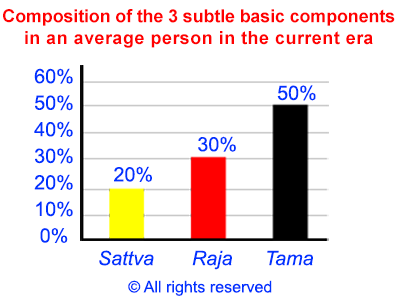
The 3 subtle basic components: Each one of us is made up of three subtle basic components or guṇas. These components are spiritual in nature and cannot be seen but they define our personalities. They are:
- Sattva: Purity and knowledge
- Raja: Action and passion
- Tama: Ignorance and inertia In an average person in the current era, the basic subtle Tamacomponent is as high as 50%.
Please read the article on the 3 subtle basic components
The more we are filled with the Raja and Tama components the more we display the following characteristics which add to our ‘weight’ and impact which plane of existence we go to in our life after death:
- More attachment to worldly things and selfishness
- More unfulfilled desires
- Feelings of revenge
- Higher amount of demerits or wrong-doings
- Higher amount of personality defects such as anger, greed, fear, etc.
- A higher amount of ego: By ego we mean how much a person identifies himself with his body, mind and intellect as opposed to the soul within
- Resulting in lower spiritual level
A permanent reduction in the proportion of the subtle basic Tama component and the related characteristics mentioned above come about only with sustained spiritual practice according to the six basic laws of spiritual practice. Psychological improvements with self-help books or trying to be nice are at best superficial and temporary.
6.1 Importance of the mental state at the time of death
The mental state at the point of death, apart from what has been mentioned above, is very important. Our mental state is generally relative to the proportion of the subtle basic components in our being.
If a person is actually doing his spiritual practice such as chanting the Name of God at the time of death then the influence of desires, attachments, ghosts, etc. are minimal possible for that person compared to his state when not chanting. This makes his subtle body lighter. Hence, if he passes away while chanting, he attains better plane of existence among the sub-planes than what he would have attained were he to pass away without chanting.
At the time of death, if a person is chanting the Name of God and is also in a state of surrender to God’s will, then he attains an even better plane of existence in his life after death and his sojourn is undertaken with lightening speed. This is because the person being in a state of surrender on Earth plane of existence itself, has very less chance of increasing his ego in his life after death. Also, the entire responsibility of his well-being in his life after death is undertaken by his evolved spiritual guide (Guru).
6.2 Who goes to Hell?
The following are the types of deeds in our life on Earth that typically land us in one of the planes of existence of Hell.

The extent, duration and intention behind the wrong-doings are important factors deciding the planes of existence of Hell attained after death rather than just the action itself.
7. Suicide and the after life
There are two types of death with regards to its timing.
Destined final death: This is the time of death that no one can escape.
Possible death: This is where a person can possibly die. Each person may undergo a possible death wherein one comes close to death but may be saved due to his or her merits.
For more information on the types of death please refer to our article – Time of Death
In cases where a person is going through insurmountable crisis in his life or has severe personality disorders, he may think of taking his own life in a depressed state. Ghosts (demons, devils, negative energies, etc.) also fuel the depression of a suicidal person and sometimes are instrumental in pushing a person over the edge into committing suicide. However, in most cases, suicide remains a wilful act that happens when a person is going through a possible death phase as per their destiny.
Life on the Earth plane of existence is precious and is given to us primarily for spiritual growth. When we kill others, we create/settle a karmic give-and-take account with them. However by committing suicide, we squander away the opportunity for spiritual growth and hence incur demerits or sin. The gravity of sin can vary depending on the circumstances under which a person commits suicide. Invariably the subtle-body of an average suicide case will go to Bhuvarlok. However for greater sins incurred during their life and the circumstances under which they commit suicide they can go to the lower regions of Hell.
- Killing a Saint incurs the maximum amount of sin and on a scale of 0-100, it is 100.
- Killing an ordinary person incurs 40 on the same scale
- Killing oneself incurs 30% sin as opposed to killing another person of average spiritual level. Generally people who commit suicide are at a lower spiritual level. Their spiritual level gets eroded due to continuous depression.
| Cause | Sin incurred | Merits | Comments |
|---|---|---|---|
| Where only oneself is involved | |||
| Physical: If one is experiencing severe pain or terminally ill due to illness and cannot take the pain any more voluntary euthanasia. | 30% of killing another person of average spiritual level | – | Refer to the article on Euthanasia – Section 4.2 |
| Psychological: Severe depression, psychiatric patient | 30% of killing another person of average spiritual level | – | |
| Spiritual: Taking one’s life when totally under the command of negative energies | 0 | – | The subtle body-continues to be under the influence of negative energies after death. Intense spiritual practice helps to come out of the clutches of demonic possession. |
| Where others are involved | |||
| Sacrificing oneself to save others selflessly | 0 | Varies | Depends on who one is sacrificing for. If sacrificing oneself for an evil person then one in fact incurs demerits and not merits. |
| Sacrificing oneself to save a Saint’s life | 0 | 100 | Saving a Saint’s life accrues the highest amount of merits. |
| Suicide bomber (killing oneself and others) | Varies | Varies | As per cause. For example if a soldier were to kill Hitler in a suicide mission to save millions of lives and rid the world of a menace, then merits would be accrued. Alternatively if a suicide bomber killed innocent adults and children then only demerits would be incurred. |
8. Why is there a time lag between two reincarnations?
In the course of research by using hypnotic trance to trace the past lives of the person, it has been found that the time lag between two reincarnations on Earth could be on average 50 to 400 years. The reasons for this time lag are as follows:
- The subtle body remains in the Heaven or the Nether plane of existence for variable periods of time to undergo its merits and demerits (sins).
- Circumstances on Earth plane of existence need to be favourable to complete the give-and-take account from previous births with various people. This is in accordance with the law of Karma. The reincarnation of the subtle body is postponed until the time various other people who they have a give-and-take account with are also preparing to take reincarnation.
- Sometimes in past life regression, a person does not report a reincarnation in the trance state. The reason for this is that a certain reincarnation has been very uneventful or brief and the person may not remember any details of it.
In the case of subtle bodies that have been relegated to the deeper planes of existence of Hell, the time lag between two reincarnations may be thousands of years. They stay in their respective plane of existence of Hell until such time they have completed their punishment. In most cases, this means languishing in plane of existence of Hell in their life after death till the dissolution of the Universe.
9. Life after death – in summary
The above facts about the various planes of existence give us a fair idea of the possible consequences in our life after death of how we live our lives. Only with spiritual practice or with extreme meritorious deeds can one go to the higher planes of existence and thereby avoid unhappiness and punishment and enjoy higher levels of happiness. There are also better chances of a reincarnation on Earth plane of existence in circumstances conducive to spiritual practice. This is so that one moves further up in the subtle planes of existence in the Universe. As we go further into the current Era of Strife (Kaliyug), there is lesser likelihood of people going to the higher planes of existence.
Once we go to the lower planes of existence such as the Nether plane of existence or other planes of existence of Hell, we stay there and experience severe unhappiness for centuries until we completely pay for our demerits (sins) by suffering the intense punishments meted there and get a chance to be reincarnated on Earth.
To do consistent spiritual practice on the Earth plane of existence according to the 6 basic laws of spiritual practice is like swimming against the tide in the current era. However, it is also a guaranteed way of advancing to higher planes of existence in our life after death.
Friday, July 10, 2015
Don’t Take a Vacation from Healthy Habits

Caron Watt and her husband are feeling pressed for time these days. They’ve got about an hour after work each night to squeeze in quality time with twin 22-month-old sons Shane and Dylan, and big sister Edie, 5, before the bedtime routine.
“What’s really falling off are family meals, and I have a lot of guilt about that, because I know it’s important,” says Watt. The kids usually eat early with their babysitter, and on weekends it’s often easier to feed the kids simple food and enjoy some grown-up time once they’re in bed. She’d like them to have more outdoor exercise, too, but rarely finds the chance to fit in an evening trip to the playground.
Like so many parents, Watt is keenly aware of the gloomy statistics: One in three Canadian kids is overweight or obese; only seven percent get enough exercise; and Type 2 diabetes—once unheard of in kids—now accounts for as many as half of the childhood cases seen at clinics in some parts of the country. Some researchers even say our kids’ generation could be the first with a life expectancy shorter than the one before.
How did we get into this situation and, given the many demands of modern parenthood, how do we fix it? The trickiest areas—food, stress, activity and sleep—on their own aren’t altogether surprising, but they’re all connected—so when you fix one, it has a domino effect on the others. Fortunately, the solutions are simple enough to start today.

“The time for made-from-scratch family meals is getting squeezed and squeezed,” says Kristen Yarker, a registered dietitian from Victoria who focuses on family nutrition. With less time for meal prep, we rely more than ever on quick takeout meals and fatty frozen dinners that are high in calories and low on nutrition. As a result, one in three Canadian children is now overweight or obese. “The nutritional environment has changed dramatically over the past few decades,” says Jill Hamilton, a paediatric endocrinologist who is director of both the Centre for Healthy Active Kids at SickKids as well as the SickKids Team Obesity Management Program. Portion sizes have gone up while quality has gone down, particularly for families with limited means, since fresher options often cost more. And junk and processed food is everywhere, says Hamilton, from candy at kids’ eye level in stores to pizza days and birthday cupcakes at school. Plus, with family time at a premium, it’s sometimes easier for stressed parents to give in when picky kids beg for processed chicken fingers rather than face a mealtime standoff over new foods. “The research shows that it takes anywhere from 10 to 30 times for a child to try a food before they like it,” says Yarker. Not surprisingly, parents usually give up after five, she says.
The Fallout
In kids, unhealthy weight (measured using the body mass index, not just the scale) leads to earlier onset of increasingly common conditions like diabetes, heart disease and cancer. It’s this trend that led researchers at The University of Illinois and Children’s Hospital Boston to conclude that the current generation of kids may have a shorter average lifespan than ours, and that obesity is already shortening average life expectancy more than accidents, homicides and suicides combined.
The fix
Cutting out sugary drinks is an easy and effective place to start. Pop, sports drinks and juice—even the kind misleadingly labelled “unsweetened”—are packed with sugar and little else, says Hamilton. Next, plan meals on weekends, which is key for pulling off healthy food during the week, says Yarker. “People often resist it, but it really does save a lot of time and stress. You don’t have that 4 p.m. panic and end up going to a drive-through.” Instead, make precut and prewashed veg your go-tos—spending a little more can save the cost of takeout if it speeds up dinner prep.
Sherrie-Mae Guthrie, a mom of three from North Grenville, Ont., is on the road 218 kilometres (135 miles) a day Monday through Wednesday, first getting to and from her work as an elementary vice-principal and then to her 11-year-old daughter’s competitive swim practices. Guthrie makes morning smoothies, sets the slow cooker and packs portable dinners of veggies, sandwiches, and cheese and crackers for the car rides.
And remember, it’s not just what you eat but also when you eat that’s important. Skipping breakfast leads to overeating later in the day, says Hamilton, even in kids. They should be eating regularly throughout the day and not filling up on snacks right before bed. And if your kid is overweight—something that can be hard to see objectively without the help of your doctor—be careful to make healthy changes as a family and not single him out, she says. “We can all eat a little better. We can all move more.”

The World Health Organization has said that stress is the biggest global health problem we face—bigger than HIV. At the root of kids’ stress (and also a barrier to sleep) is overscheduling, says Shimi Kang, medical director for child and youth mental health for Vancouver community programs, and author of The Dolphin Parent. Children participate in more structured activities today than in the past, she says, resulting in a loss of an average of eight hours a week of free play over the past two decades—and it’s not doing our kids any favours. “Free play is highly protective against the physical and biological manifestations of stress,” she says. It reduces adrenalin and stimulates the part of the brain that works through problems.
Playtime also allows for bonding with friends, another important way of managing stress, says Kang. She adds that parents may incorrectly assume their kids get plenty of social time in their extracurriculars. But those activities are by nature highly structured, with a lot of listening to the grown-up in charge, and can crowd out more organic opportunities for fun and friendship. Another thing that can stress kids out: watching us frown over work email as we focus more on our devices and less on them, says Sandra Mendlowitz, a psychologist with the outpatient psychiatry program at SickKids in Toronto.
The Fallout
Stress is good when it prompts kids to jump out of the way of a car or sprint to the finish at a track meet. But constant stress has all kinds of negative consequences for their overall well-being. It leaves their bodies awash in adrenalin and cortisol, essentially in a state of hyperarousal that—even in kids—can lead to high blood pressure, headaches and digestive disorders like colitis, and can worsen existing conditions like asthma or diabetes. “When you are highly stressed, you’re more vulnerable even to the simple cold,” says Mendlowitz. Also, a loss of social connection—when free play is sacrificed, for instance— has been shown to shorten lifespan. In an extreme example, tumours are more likely to metastasize in cancer patients who experience loneliness.
The fix
Your undivided attention is simply your best tool to help your kid learn to manage stress. “Parenthood is a full-contact sport—that means that parents need to pay a lot of attention to their children,” says Denis Daneman, paediatrician-in-chief at SickKids. He credits the success of his two grown children in part to the habit of having dinner together each night, no matter what was going on. Try leaving your phone in another room and really engage them in conversation after school, Kang says. Kids crave different types of attention depending on their ages and personalities, but whether you’re cuddling your small one or hiking with your eldest, “the key is being fully present in that moment.”
If you’re an overscheduled family, take a hard look at cutting back on some of the activities that crowd your calendar. There’s so much pressure to entertain and enrich them and keep them physically active, but the truth is they’re way better off if some of their exercise comes from running around the backyard. Prioritize downtime, sleep, play and time with friends, and then fit extra-curricular activities around these, not the reverse, suggests Kang.
To balance the swimming, gymnastics, soccer, baseball and hockey that keep her three kids busy during the week, Guthrie’s family plans very little on weekends, leaving lots of space for her kids to do what they please. “We have a play structure and pool in our backyard, and the neighbourhood kids come and play. That free time is completely their own,” she says.
And no matter how things are going today, it’s good to know the early warning signs of mounting stress. Avoidance is the hallmark of anxiety, says Mendlowitz. So if your child normally loves dance class but has been asking to skip it lately because she’s tired and overwhelmed, it might be time to drop something. Changes in behavior, appetite, sleep and irritability can all signal elevated stress, and warrant an appointment with your child’s physician.

The just-released 2015 ParticipACTION Report Card on Physical Activity for Children and Youth shows that 85 percent of three- to four-year-olds get more than the recommended one hour of screentime per day, and 76 percent of five- to 11-year-olds get more than the suggested two hours of screentime. But we can’t blame the shocking rise of sedentary behaviour on TVs and smartphones alone. We’re a safety-obsessed generation of parents, much less likely to allow kids to walk to school, ride their bikes around the block or play outside unsupervised. “When we have schools banning tag at recess or banning balls, those are adults’ decisions that make it harder for kids to be traditionally active,” says Cole Wilson, president of the Saskatchewan Physical Education Association. And it’s not just schoolyard scrapes we’re trying to prevent. “We worry about child abduction, when the stats show there’s a very low potential for that to happen,” says John Elkins, program specialist for physical education, health and science in the Newfoundland and Labrador English School District.
The fallout
Physical activity is enormously important for our children’s overall health, not just for physical fitness but for lowering stress-hormone levels and helping them sleep better, says Hamilton. And because most kids don’t walk or bike to school these days and are generally more sedentary overall, they come to school less prepared to learn, adds Wilson. “Those who are physically active and in shape do better academically.” A review of research conducted by the Centers for Disease Control and Prevention found that physical activity can help improve academic achievement, including grades and standardized test scores, by improving attention and information processing, as well as helping kids cope with stress. Those who get less exercise also tend to get less outdoor time, and miss out on the immune-boosting and mental health perks of being in nature, says Kang.
The fix
Start by putting limits on screentime, even if you have to withstand major whining about being bored. “Don’t let the iPad be the babysitter,” says Wilson. Kids will naturally be more active when they’re away from the hypnotic glow of their devices. Elkins says parents can also help by advocating for good physical education programs, like active recess and intramurals, for their school-aged kids. “Many of these programs rely on volunteerism, so parents who have a skill set should try to help provide those opportunities for kids,” he says. Or do your neighbors a solid by taking their kids along when you head to the park to kick a ball around with yours.
Start by putting limits on screentime, even if you have to withstand major whining about being bored. “Don’t let the iPad be the babysitter,” says Wilson. Kids will naturally be more active when they’re away from the hypnotic glow of their devices. Elkins says parents can also help by advocating for good physical education programs, like active recess and intramurals, for their school-aged kids. “Many of these programs rely on volunteerism, so parents who have a skill set should try to help provide those opportunities for kids,” he says. Or do your neighbors a solid by taking their kids along when you head to the park to kick a ball around with yours.
Don’t let their skating lessons make you complacent. A once-weekly class doesn’t necessarily teach them how important it is to keep moving all the time—but being active as a family does. Build exercise into your lifestyle by walking places, opting for bowling over movie night or just hanging out together outside. Since a simple park outing with her twin toddlers is such an undertaking, Watt has made their backyard a great space for them to run and play. “We’ve got the boys fenced in back there so they can climb on their toys and ride their plastic trucks.”

Canadian data shows that 40 percent of our children are sleep deprived simply because they’re too busy, Kang says. We’re raising children in a “toxic culture of busyness,” she warns, that’s robbing us of downtime and shut-eye. Two-career households, long commutes, jam-packed extracurricular schedules and technology that keeps us up at night—all have pushed bedtimes back for parents and kids alike. School-aged children aren’t getting the minimum 10 hours they need, and toddlers and preschoolers, who need between 10 and 13 hours, often fall short, too.
Guthrie admits hers is an “overbusy family.” In addition to her eldest’s competitive swim practices, she has another daughter, 9, who’s a competitive gymnast, and a six-year-old son who plays baseball, soccer and hockey. On swim days, Guthrie is up at 4:30 a.m. to prepare meals and get ready for the day.
In many cases, parents are not setting a strong example for their kids around good sleep habits, says Jean-Philippe Chaput, a health scientist at the Children’s Hospital of Eastern Ontario and an associate professor at the University of Ottawa. Most people see sleep as a waste of time and don’t recognize the benefits for overall health, he says, and they pass that mentality down to their kids. We may intend to turn in at a decent hour but inevitably get waylaid by the dishes, permission slips and unread email—those same things can distract us from getting our kids down as well.
Another part of the problem is that parents may not be enforcing consistent sleep routines for their children. Mendlowitz says she’s noticed a decline in parental resolve in the 20 years she’s been working with families. “They basically lack confidence in their parenting skills. When they don’t set rules around independent sleeping, it tends to disrupt everyone’s rest and makes kids dependent on their parents to fall asleep,” she says. When you’re exhausted, it may seem easier to lie down with your child while he falls asleep or to simply scooch over a little when he climbs into your bed at night, she adds. “But the longer it goes on, the longer it will take to stop.”
The fallout
Chronic sleep debt affects nearly every aspect of our health. “Number one, it leads to obesity,” says psychiatrist and sleep specialist Atul Khullar, who treats kids at an Edmonton sleep clinic. At any age, studies show, we eat more when we stay up late. Inadequate sleep also affects attention and focus, which can impact the way kids learn and behave in school. And it’s directly linked to poor mental health; a recent Norwegian study found that children who had sleep problems, even as young as four, were at greater risk for psychiatric issues like anxiety and ADHD by age six. Lack of sleep is also tied to heart disease and diabetes, adds Kang. “I tell parents, ‘You might as well just give your eight-year-old a pack of cigarettes.’ Sleep deprivation is that bad for their health.”
The fix
If you know your child isn’t getting enough rest, take heart that even a little more sleep goes a long way. “You’ll get some benefits even with 15 extra minutes,” says Khullar—but, he adds, 30 to 60 minutes more is even better. Inch bedtime a little earlier to begin, or see if you can tweak your morning routine to give kids a slightly later wake-up. Parents of toddlers and preschoolers could also introduce rewards for staying in bed, says Mendlowitz. You can’t control when they fall asleep, she adds, but you can establish firm expectations about going to bed and staying there during certain hours. “The best plan is to have regular sleep and wake times, even on the weekends.”
Also be sure to model good behaviour, especially with electronics. Even toddlers can get hooked on the family iPad, and the light cast by these devices can trick our brains into thinking it’s daytime. Create a household tech blackout an hour ahead of bedtime (parents too!)—instead of video games, make time for reading, baths and quiet chats in bed. Or get some exercise together. Everyone will fall asleep more easily and get a better night’s rest after a quick walk or bike ride around the block.
More on MSN:
Wednesday, June 10, 2015
Think of your body like it's
a temple: It's yours to use, but there are some sacred spots you shouldn't put
your grubby hands on.
"Research shows that
hands play a major role in the transmission of germs," says Kelly
Reynolds, PhD, an associate professor in the Zuckerman College of Public Health
at the University of Arizona. "Even after proper washing, hands and
fingers are rapidly re-contaminated from the surrounding environment."
That's especially true if
you haven't clipped your nails lately, or if you sport some bling. Research
from the University of Nebraska suggests that people who wear rings or keep
their fingernails 2 millimeters or longer tend to carry more microbes on their
mitts. "My opinion is that the easier it is to clean your hands, the
better off you are," says study author Mark E. Rupp, MD, professor and
chief of the division of infectious disease at the University of Nebraska
Medical Center.
The next step: keep your
paws off these body parts
as much as possible.
1. Your Ear Canal
You should never stick your
fingers—or anything else—in your ears. "Introducing anything into the ear
canal can tear the thin skin that lines the ear canal,” says John K Niparko,
MD, professor and chair of the department of otolaryngology-head & neck
surgery at the Keck School of Medicine of USC.
If you feel a persistent
itching sensation in your ears, see an otolaryngologist rather than trying
something DIY. "An otolaryngologist can assess the problem—whether it be
wax accumulation, eczema of the skin, or infection—like swimmer's ear, for
example. A tailored program of treatment, ear hygiene, and moisturizing of the
skin should be put into play," says Niparko.
2. Your Face
You can use your hands to
wash your face or apply skincare. But otherwise, keep your paws off. When you
rest your hands on a germy surface and then bring them to your forehead, it
increases your likelihood of getting sick—and breaking out, too. Your fingers
contain oils that can plug your pores, says Men's Health dermatology advisor
Adnan Nasir, MD.
3. Your Butt
Wiping and washing aside,
just don't. "The anus does contain bacteria that could potentially be
harmful," says Jared W. Klein MD, PhD, medical director of the after care
clinic at Harborview Medical Center. After you poop or touch your butt for any
other reason, wash your hands thoroughly.
4. Your Eyes
Unless you're putting in
contacts or washing away a particle that found its way into your peepers, keep
them off limits. You can easily introduce germs into your eyes, says Men's
Health ophthalmology advisor Kimberly Cockerham, MD. Those bugs could cause
anything from pinkeye to a scarier infection. Follow her simple rule:
"Don't touch and don't rub." And if you do experience itchiness,
dryness, or contact lens discomfort, talk to your eye doc. He or she can
address the underlying issue.
(For 2,476 smart, simple
ways to stay healthy for life, check out The Better Man Project—the brand-new
book from the Editor in Chief of Men's Health. You'll find cool life hacks from
doctors to improve your health, fitness, nutrition, sex, and more!)
5. Your Mouth
Recent research from the
U.K. found that people put their fingers on or around their mouths an average
of 23.6 times per hour when they were bored at work. And they still did it 6.3
times an hour when they were busy! That's a problem: In a landmark study
published in the Journal of Applied Microbiology, a third to a quarter of germs
tested transferred from study subjects' fingers to their mouths. Maybe you
should think about stealing your kid's pacifier.
6. The Inside of Your
Nose
Quit digging for gold: In a
2006 study of ear, nose, and throat patients published in the journal Infection
Control and Hospital Epidemiology, nose pickers were 51% more likely to carry
Staphylococcus aureus bacteria in their schnozzes than those who kept their
hands off.
Subscribe to:
Posts (Atom)